Techkeyfactor: MOBILE
Showing posts with label MOBILE. Show all posts

Nokia brings its biggest Lumias yet, including a Windows RT tablet

Posted by MH ,

New Lumia phones sport 6-inch displays.


by  - Oct 22 2013, 5:55pm WEDT


To open Nokia World 2013 in Abu Dhabi, former CEO Stephen Elop unveiled Nokia's first tablet alongside several new handsets. Rumors had been building that some bigger Lumias were coming, with Windows Phone Update 3 including support for 1080p phones, and fuzzy pictures of increasingly larger handsets being leaked. Looking over the lineup and specifications, there's a lot to like in the new Lumias.

Lumia 2520—10.1 Windows RT Tablet
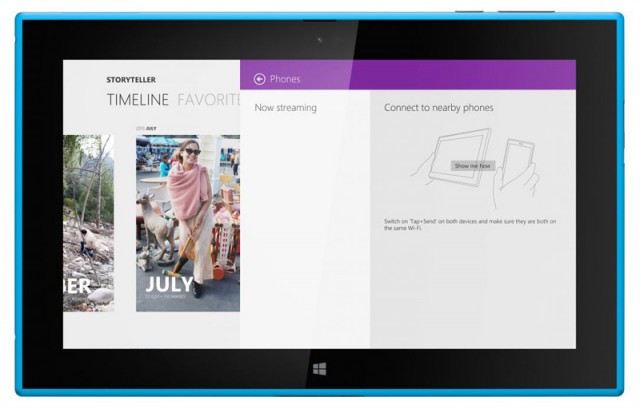
Nokia's 10.1-inch Lumia 2520 Windows RT Tablet.

Nokia has always had the design chops to make covetous devices, and with its first Windows tablet you get the same design language, just bigger. The Lumia 2520, Nokia's first Windows RT device, moves the company into direct competition with the newly launched Surface 2. The 10.1-inch slate features a 1080p display, Qualcomm Snapdragon 800 SoC, LTE, Wi-Fi, and a 6.7MP rear camera with Zeiss optics and an impressive f/1.9 aperture. The display's touch interface features the same capacitive layer we've seen from other Lumias, so you won't need to take off your winter gloves in order to operate the tablet.
Windows RT 8.1 drives the device, and Nokia has included ports of some of its suite of Windows Phone apps, including Here Maps for offline navigation and Nokia Music and Mix Radio. Two new apps, Storyteller and Video Director, make keen use of the camera. It's little surprise that Nokia would attempt to offer a premium camera experience on any of its devices, even if cameras on tablets aren't traditionally a priority. That Nokia's focus is on video rather than still shots hints that the company has researched user behavior and expects video to be the primary use case for a device this size.
Aping the Surface 2's accessories, Nokia is releasing the Power Keyboard cover. Featuring a keyboard and touchpad, the cover also has an additional battery and two USB ports. The wrap-around cover looks to be a mix between Microsoft's Touch Cover and Type Cover, offering physical keys with a soft-touch body. Nokia reports battery life in the 16-hour range with the Power Keyboard attached and 11 hours without it. Nokia has also baked in its charging tech, which it claims allows for 80 percent of battery life to be recovered in just one hour of charging.
The Lumia 2520 comes in at $499 and will be available in red, cyan, white, and black. The $50 premium over Microsoft's Surface 2 nets you LTE and NFC, though no 64GB option has so far been announced. The Power Keyboard cover will cost you another $149. Sales will begin to roll out in the US, UK, and Finland shortly, with other markets rolling out soon after. In the US, versions will be available for both AT&T and Verizon, with the AT&T device supporting both 3G and LTE and the Verizon one being pure LTE.

Lumia 1520 and 1320—big phones, different prices
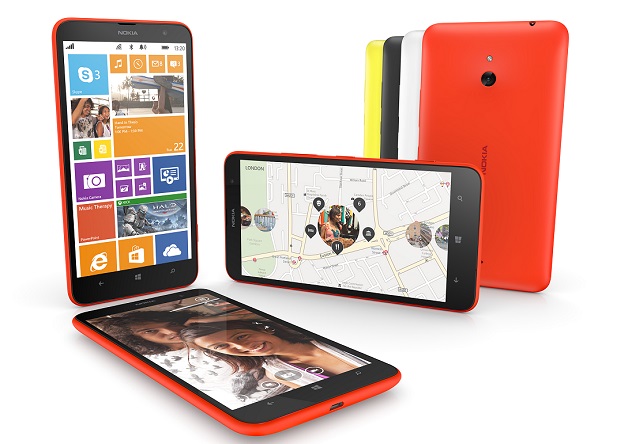
Nokia Lumia 1320.

The Lumia 1520 and 1320 extend the recipe Nokia used for the Lumia 1020—with some choice substitutions. The 1520 is the new flagship, though it doesn't have the ultimate camera. Featuring a 1080p 6-inch display, Qualcomm Snapdragon 800 SoC, 2GB of RAM, and a 20MP PureView camera, the 1520 comes laden with all the advances you'd expect—and a premium $749 price tag to match. The large volume allows it to house a 3400 mAh battery and a microSD slot to compliment the 32GB of onboard flash. A new addition to Nokia's camera software is the ability to shoot in RAW, a feature that will come to the Lumia 1020 in a later update. The 1520 will be exclusive to AT&T when it launches in the US.

The 1320's price, $339, gives you a good idea of what you'll find inside. While still a 6-inch device, the 1320 makes do with a 720p display (a rarity among Nokia's Windows Phone 8 devices, which have tended to favor 768p) and a Snapdragon 400 SoC. The phone is aimed at those who still have an interest in large devices but don't want to spend the big bucks to get one. And although it isn't the powerhouse of its stablemate, it does retain the 1520's 3400 mAh battery. Omitted, though, is the PureView camera; Lumia 1320 buyers will have to be content with a 5MP shooter, though the same video and camera software suite will be made available.
These two approaches to the "big phone" market should cover all the demographics interested in larger devices, and they are somewhat enabled by the advances Microsoft made in its GDR3 update.

Asha—For the rest of the world
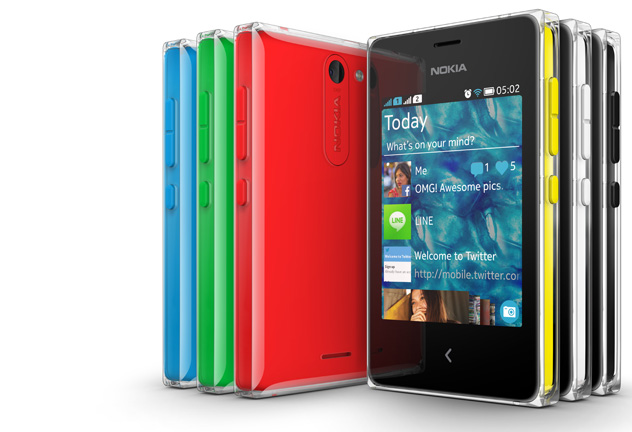
Nokia's Asha Phones: Just as colorful, oh so affordable.
US readers are likely unfamiliar with Nokia's Asha platform, though folks in the developing world probably are. Not quite a smartphone platform, Asha has been at the heart of Nokia's push into emerging markets around the world. The new handsets (Asha 500, 502, and 503) are all priced below $100 and feature modest specifications while still drawing from Nokia's design language and historically high build quality. Interestingly, Microsoft will be able to use the Nokia name only with Asha phones; Lumias will presumably fall under the Microsoft or Surface brands. The challenge for Microsoft becomes helping Asha customers make the transition to Lumia phones despite losing the Nokia name. For now, you can have a brand-new Nokia Asha 500 for just $69, though I would suggest the 503 since it supports 3G data.
Listing image by Nokia.
Source: arstechnica.

Retina iPad Mini & iPad 5 to be announced October 22nd: What to Expect

Posted by MH

By 


About a month ago, on September 10th, Apple released their long awaited refresh its widely popular iPhone lineup. The company released two, brand-new iPhones (for the first time ever), the iPhone 5S and iPhone 5C. The new iGadgets brought some neat features to the table such as iOS 7, a fingerprint scanner, and a 64-bit A7 CPU, but Apple may be ready for “Round 2.”
“People familiar with Apple’s plans” tell tech site All Things D that the company is holding an invite-only and exclusive event on Tuesday, October 22. We currently don’t know where the event will take place, however.
October 22nd looks to be a big day for the world of tech. Interestingly enough, that fine Tuesday will also bring the availability of the Surface 2 and Surface 2 Pro tablets from Microsoft. Nokia is also bringing some goodies to the table on the 22nd as well. The company is expected to unleash six new devices, namely the 6-inch Lumia 1520 “phablet.” We are also expecting the unveiling of the heavily leaked and rumored Google Nexus 5 flagship smartphone along with Android 4.4 “KitKat” around the same time frame.

Apple seemingly has a lot on the agenda for the 22nd.We are expecting to see an iPad lineup overhaul with the addition of a completely redesigned full sized iPad will smaller bezels paired with a more iPad Mini-esque architecture and an iPad Mini with a higher-resolution Retina display (though recent reports have shown this has a 50/50 chance of actually dropping). The new iPads will most likely follow in the footsteps of the iPhone 5S by introducing things like a 64-bit chip and a fingerprint scanning home button.
On the Mac side of the spectrum Apple’s latest computing OS, OS X Mavericks, will undoubtedly make an appearance and broadcast a release date. The long awaited refreshed Mac Pro will also become available to customers soon after the event, and might even bring some R2-D2 nostalgia to Star Wars fans everywhere. We can also look forward to updated MacBook Pros sporting Intel’s latest and greatest Haswell CPUs for huge jumps in the battery life department.

If Apple confirms the date, mark your calendar, because there will be a load of new gadgets just around the corner.

Google Play App Roundup: Circa, Kingdom Rush Frontiers, and Shadowrun Returns

Posted by MH

BY RYAN WHITWAM 
News, towers, and cyberpunk.

The days are growing shorter as winter approaches, but you don't need to be bummed. That's just more time you get to justifiably spend curled up with a smartphone or tablet. Although, you want the best apps and games to keep you company, so the Google Play App Roundup is a good place to start. This is where we go over the best new stuff on Android every week. Just click the links to head right to Google Play.
This week news gets more mobile, the kingdom is again under attack, and the future gets magical.

Circa

There are already RSS readers, web browsers, and untold mountains of apps for single news sources like newspapers and blogs. So why do we need another one? Well, none of those news sources are created with mobile in mind. Circa is an app that gathers information from multiple sources, then builds a timeline for each story that you can scroll through and get the relevant details complete with citations.
Circa uses the Holo guidelines when it makes sense, and tweaks things to improve the design. It has the Android hamburger navigation panel on the left, but doesn't use an exposed tab bar at the top to list the different news categories. You can still slide left and right to get between the different news categories, but the animation is a sort of fading slide-in -- it looks really neat.
Each story is brought up in a new screen (on phones) with a vertically scrolling list of tidbits. Each entry is a different aspect of the story with a link to the source. This allows you to figure out what's going on in general, but also dig into certain aspects of an event. If you're particularly into a story, it can be added to your favorites and the app will notify you in the background when new info is available.
Circa is optimized for tablets with a two-column UI that let's you see a timeline while still scrolling through the list of stories. There's also a cool home screen widget that can list stories from whatever category you want.
This isn't an automated process, but a human-powered editorial endeavor. As such, you won't see the same information rewritten from five different sites and the longer articles on a topic will be distilled down in an intelligent way. Circa seems very useful and its free.

Kingdom Rush Frontiers

The original Kingdom Rush has been one of the top games in Google Play ever since it arrived early this summer. Now the sequel, Kingdom Rush Frontiers has hit Android, and there is really nothing to dislike here. This title brings more of the killer tower defense action from the original, but with new heroes and towers to play with.
Some Android users automatically ignore tower defense games, and you almost can't blame them -- there are a ton of very similar games out there. Kingdom Rush Frontiers sets itself apart by offering very well-balanced gameplay with various additional tasks, and even some almost RPG elements.
The core tower defense elements are all there, so you can get up to speed quickly in Kingdom Rush Frontiers. Each level has one or more entry and exit points for the creeps. You just have to stop them from getting to the exit by throwing up towers along the predefined path. There are ranged towers like the archers, artillery, and mages. Then you also have ground infantry barracks. You have to combine all these for an effective strategy. Additionally, each tower has two different upgrade paths with a few special powers that can be added. Basically, there's a lot of variation in the gameplay.
There is also the hero system to play around with in Kingdom Rush Frontiers. You get three heroes for free in this title, but the game also offers you the option of buying more with real money. You don't have to do thi, but it's a way to get a little more out of the game. Whichever hero you use, he/she/it will gain experience and level up, allowing you to add new skills. While you can move the hero around the map as you like, the attacks are automatic.
Kingdom Rush Frontiers does an impeccable job of keeping you interested -- it's never a lazy TD game. Sometimes new paths will appear mid-game, or an enemy will disable or destroy some towers. It's a really engrossing experience from beginning to end. This is also a fully updated version of the game, including the new tropical-themed campaign that was just added to the iOS version.
The graphics are essentially identical to the first game, which is totally fine. Kingdom Rush Frontiers has a strong cartoon vibe with strong lines and simple textures. The visuals are quirky and fun with a sprinkling of nerd references. The game also runs flawlessly on any modern Android device.
Kingdom Rush Frontiers is absolutely worth the $2.99 price. I'd pay even more because it's just that great.

Shadowrun Returns

The classic tabletop role playing universe Shadowrun is back, and this time the original creator is working behind the scenes to make sure everything fits within the Shadowrun cannon. Shadowrun Returns is a turn-based RPG that pulled in almost $2 million on Kickstarter last year. After debuting on PC earlier this year, the game is now on Android. It's pricey at $9.99, but it has the potential to scratch your RPG itch like few mobile games can.
Just like a regular non-mobile RPG, you get to choose your character's race, gender, and class at the start of the game. Shadowrun is set in a future where magic has returned to Earth. So you can be a human, elf, orc, troll, or dwarf. The classes include tech-focused options and magical ones. Shadowrun Returns is an interesting mix of gritty cyberpunk technology and spells, and you don't have to restrict yourself to one or the other. Nothing is stopping you from starting as a Rigger with a group of combat drones, then leveling your spellcasting skills.
The story and dialog in this title are very well done. The characters are believable and there is a remarkable lack of cringy one-liners. This isn't an entirely open world game -- Shadowrun Returns sends you from one location to the next, but you can usually wander around in these areas.
Getting around and interacting with objects is as easy as tapping anywhere on the screen. When combat starts, it's all turn-based, which means strategy and planning are essential. Each member of your party gets a chance to do some damage, then the enemies get their turn. Each mission will probably have one larger skirmish and possibly a smaller one at the beginning. The balance seems good overall, but you need to properly develop your character's strengths and play to them.
The graphics in Shadowrun Returns remind me quite a lot of the old Fallout games. The textures have been pumped up a bit, but it still has that static look indicative of isometric top-down games. The lines are clean and the lighting effects look good. Shadowrun does what it needs to visually without wasting resources.
Shadowrun Returns is not without its issues, though. The game still has some bugs that will stymie your progress on occasion. In fact, I couldn't get the Rigger skills to work half the time. The spaced-out autosaves are also an issue -- you have to play for at least 20-30 minutes to make any real progress. If you jump into another app for any reason, Shadowrun Returns will probably be killed by the system because it uses a lot of RAM.

Despite the issues, Shadowrun Returns is fun. The RPG elements are solid, and the story is engaging. It's also a really cool world with advanced technology existing alongside magic. Casual gamers might want to hold out for some improvements, but RPG fans can probably justify $9.99 for 12 hours of cyberpunk questing.
Source:Tested.

Samsung Galaxy Note 3's Diamond Sub-pixels Mask PenTile's Weakness

Posted by MH

BY WESLEY FENLON 
DisplayMate finds no flaw with the Galaxy Note 3's new OLED display, which is incredibly bright and pixel dense.

DisplayMate's latest investigation into mobile display technology reveals that Samsung's Galaxy Note 3 has one hell of a screen. Not only is the resolution doubled, from 720p to 1080p, but it's "the best performing OLED display to date across the board, including picture quality and color accuracy." More importantly, the Note 3's brightness maxes out at an incredibly bright 660 cd/m2, much higher than the Galaxy S 4's 475 cd/m2 and the iPhone 5's 556 cd/m2.
PHOTO CREDIT: FLICKR USER RETROCACTUS VIA CREATIVE COMMONS

OLEDs are making huge gains on LCDs, and one of the key factors is the arrangements of subpixels Samsung uses in its displays. In the past, Samsung's PenTile pixel arrangements have been criticized for damaging image quality, and one look at a macro comparison between an LCD screen and an OLED screen will show you why. The issues with PenTile sub-pixel arrangements haven't disappeared, but you may not be able to notice them with the naked eye, as DisplayMate explains:
"The Galaxy Note 3 has a pixel density of 388 Pixels Per Inch PPI, which is very high, but lower than the 441 PPI for the Galaxy S4 and other Full HD Smartphone displays. It’s important to recognize that this is not a decrease in visual image sharpness because the display still appears perfectly sharp for 20/20 Vision at typical viewing distances of 13 inches or more because the Pixels and Sub-Pixels are below normal visual acuity. (The Galaxy Note is 14 percent larger than the Galaxy S4 so it is typically held further away). The Galaxy Note 3 also has a PenTile Sub-Pixel arrangement like the Galaxy S4, with only 2 Sub-Pixels per Pixel instead of the usual 3. But at these very high PPIs, it’s not visually noticeable because of the use of Sub-Pixel Rendering and the Diamond Sub-Pixel arrangement..."
That diamond sub-pixel arrangement is something new that Samsung introduced with the Galaxy S 4 and has worked into the Note 3 as well. In typical LCD displays, each pixels is made up of three red, green, and blue sub pixels. In PenTile arrangements, every pixel has a green sub-pixel, but red and blue subpixels are alternated. This makes it easier and cheaper to create a higher resolution display. Samsung's new diamond pattern further modifies the traditional sub-pixel arrangement.
IMAGE CREDIT: SAMSUNG
Here's how DisplayMate describes it: "First of all, the Red, Green, and Blue sub-pixels have very different sizes – Blue is by far the largest because it has the lowest efficiency, and Green is by far the smallest because it has the highest efficiency. The alternating Red and Blue sub-pixel PenTile arrangement discussed above leads to a 45 degree diagonal symmetry in the sub-pixel layout. Then, in order to maximize the sub-pixel packing and achieve the highest possible PPI, that leads to diamond rather than square or stripe shaped Red and Blue sub-pixels. But not for the Green sub-pixels, which are oval shaped because they are squeezed between two much larger and different sized Red and Blue sub-pixels."
LCDs may still win for sharpness and color accuracy, but the diamond pattern allows for extremely high PPIs, making it difficult for the naked eye to spot the lack of blue and red pixels.
In fact, DisplayMate writes that OLEDs may soon overtake LCDs in power efficiency, too: "We measured an impressive 26 percent improvement in power efficiency between the Galaxy Note 3 and Note II. While LCDs remain more power efficient for images with mostly white content (like text screens, for example), OLEDs are more efficient for darker content because they are emissive rather than transmissive like LCDs. In fact, Galaxy Note 3 is already 31 percent more power efficient than the Full HD LCD Smartphones we recently tested for mixed image content (that includes photos and videos, for example) with a 50 percent Average Picture Level, APL. If this keeps up then OLEDs may pull ahead of LCDs in total power efficiency in the near future…"
If going beyond 1080p is next for Samsung's smartphone displays, PenTile seems like the obvious way to go. Without microscopes, smartphone users won't be able to spot the difference in image quality at extremely high pixel densities, and OLEDs are poised to be more efficient across the board. The Note 3 received high marks in color accuracy, screen reflectance, and everything else; check out DisplayMate's full analysis for the rest of the details.

Who Would Want a Dual-Booting Smartphone?

Posted by MH


Windows Phone Central and its sister site Android Central are both hearing rumors from their contacts that Microsoft may be in early talks with handset maker HTC to drop its licensing fee for putting Windows Phone on HTC's future phones, in the attempt to keep OEMs on board with Windows Phone while Microsoft absorbs Nokia's handset business. HTC makes the 8S and 8X phones, launched last year as part of Windows Phone 8's big hardware push. Since then, the vast majority of new Windows Phone hardware has come from Nokia. The more interesting take is that the reported negotiations may include an option for HTC to include both Android and Windows Phone OS on their phones, like dual-booting on desktop PCs. It's not a strategy that I think makes much sense for the majority of normal smartphone users--having two completely different software experiences on one device taking up valuable storage capacity sounds convoluted.
Source Norman from Tested.

The Best Android Smartphone for Your Network (September 2013)

Posted by MH

BY RYAN WHITWAM

The big phone moves on in.

It's a tumultuous time for the Android device ecosystem -- Nexus devices are leaking left and right, Samsung's latest giant phone is hitting stores, and the Moto X continues to place functionality ahead of specs. That also means it's a particularly dangerous time to buy a new phone. The last thing you want is to regret your purchase almost immediately and still be staring down the barrel of a two-year contract.
To make sure you've got the best chance of success, we're going to take a look at each of the big four carriers and tell you what to buy.
                     PHOTO CREDIT: FLICKR USER JANITORS VIA CREATIVE COMMONS

AT&T

HTC was swearing up and down that the One was going to get its Android 4.3 update in the US by the end of September. Guess what didn't get updated by the end of September. Yeah, the HTC One is still on 4.1, which is rather bizarre. I have to draw the line somewhere, so I'm going to pass on the One this time around. It's okay, though. There's a new phone in town and it's a big one. I mean physically big, in addition to being a big deal. This month I think it's down to the Samsung Galaxy Note 3 and the Moto X. There really could not be two more different flagship Android phones.
The Note 3 and Moto X take different approaches to user experience, so let's go down the list and see how the features compare.
The Note 3 is all about packing in the latest and biggest hardware. It's got a Qualcomm Snapdragon 800, 3GB of RAM, a 5.7-inch 1080p Super AMOLED screen, a big 3200mAh battery, a 13MP camera and a stylus. I remember not that long ago that my computer was lower-specced than the Note 3. By contrast, the Moto X is more subtle with a dual-core Snapdragon S4 Pro coupled with always-on language and sensor silicon, 2GB of RAM, a 4.7-inch 720p AMOLED display, a 2200mAh battery, and a 10MP camera.
PHOTO CREDIT: FLICKR USER JANITORS VIA CREATIVE COMMONS
On paper, the Note 3 wins handily because all the numbers are bigger, you dig? However, specs can reach a point of diminishing returns. What really matters is how those specs affect the feature set. Maybe you're wondering why the Note 3 is at the top and not the Galaxy S4 -- it's about the features. The things the Note 3 can do with the S Pen justify the changes Samsung made to Android.
The S Pen is the centerpiece of Samsung's software approach with this device. The new Air Control is a cool pop-up menu that gives you fast access to all the neat things the S Pen can do. You can take notes and have them transcribed into text, clip web content by circling it, open floating apps by drawing a box, and search for almost anything on your phone (even doodles in notes) in a few taps.

The Moto X is about bringing the best of Google to the forefront. By using the trigger phrase "Ok Google Now," you can wake up the phone and start issuing commands. If you need to do a search or just control the phone, you can do it without even touching the device. Notifications are also handled in a very cool way. The AMOLED screen will light up pixels to show you an icon, text snippet, and a few other bits of info for your notifications. It's easy to get the gist of things without waking up the device completely. The Moto X also has almost completely stock software, and it's definitely easier on the eyes than Samsung's UI layer.
As for the physical design, Samsung is again going over the top, almost begging you to look at the Note 3 and think 'premium.' Of course, the way the company attempts that is with plastic. The back of the device is pleather with fake leather stitching. It's kind of quirky and fun, but I don't really get the aesthetic. The Moto X has wider appeal, I'd say. The device curves in all the right places, and you can get it customized through Moto Maker on AT&T. The device looks awesome.
So here's what it comes down to -- the Galaxy Note 3 is $299 on contract and the Moto X is $199. The Note 3 has better specs and a stylus, but the Moto X is small and efficient with an emphasis on voice commands. For most people, the experience with the Moto X will still be better, and you can save a little cash. However, if you like the idea of having a stylus, the Note 3 is Samsung's best phone yet.

Verizon

On Big Red the Note 3 isn't even shipping until mid-October, so we'll let that one simmer for a bit longer. Don't fret, though. There are a few devices that are worth buying on Verizon, but the playing field is very level here. There are the Moto X andDroid Maxx on one side, then the HTC One. We're going to expand a little bit and briefly look at all three this month, seeing as the One is still getting traction on Verizon. 
Starting with the Motorola software, we're looking at a mostly stock 4.2.2 experience. Even Verizon, which is famous for cramming all sorts of features and apps into ROMs has mostly restrained itself here. The UI is lovely and very consistent. The headlining features are touchless control and active notifications. You can call up Google's voice control at any time, even if the phone is asleep -- don't underestimate how useful that is. The active notifications allow you to see detailed notification information on the screen as they come in while the phone is asleep.
The only notable difference between the Moto X and Droid Maxx is the use of physical instead of on-screen buttons on the Maxx. That means you'll get on-screen menu buttons in legacy apps.
Moving over to the HTC One, this device has come a long way compared to past HTC devices. Sense 5 includes a number of unique features like Zoe and BlinkFeed. While cool, in my experience these tend to be a little gimmicky in the long run. The UI won't appeal to everyone -- it's a bit heavier than stock Android, but still better than Samsung's take on UI. This version of the One also has the advantage of running Android 4.2 while other US variants are running 4.1.
When it comes to hardware, both devices have Motorola's X8 computing platform, 2GB of RAM, and 16GB of storage. The place they diverge is in the screen and battery. The Maxx is 5-inches at 720p, and the Moto X is 4.7-inch at 720p. Both are full RGB AMOLEDs. The Maxx knocks it out of the park when it comes to battery life with its 3500mAh Li-ion cell. It will easily last two days, whereas the Moto X with its 2200mAh battery is good for a full day. Aesthetically, the Moto X is a somewhat more attractive device, at least in general. Some people probably like the faux-kevlar thing on the Maxx.
The HTC One's design is flat out great -- the Aluminum unibody shell is slick. Around front is a 4.7-inch Super LCD3 panel at 1080p. It's a gorgeous screen -- probably the best you'll get on a smartphone this year. The One is a bit hefty and the BoomSound speakers add some height. They are great speakers, though.
The HTC One's internals are a bit more powerful than the Droid devices with a 1.7GHz quad-core Snapdragon 600, a 2300mAh battery, and 2GB of RAM. It obviously won't be able to stand up to the Maxx in battery life, though. Both the Motorola devices have mediocre cameras, but they capture more detail in bright light than the 4MP Ultrapixel sensor in the One. HTC's phone does much better in low light, though.
We're left in much the same place as last month. Each device has a selling point -- the One has better specs, the Maxx runs forever, and the Moto X has the same good software as the Maxx with better hardware design. The Moto X and HTC One are $199 on-contract, but the Droid Maxx is $299.
The extra $100 for the Maxx is only worth it if you can't be bothered to plug in your phone at night, or you're incredibly paranoid. Between the One and the Moto X, I think the Moto X is the winner, but it's admittedly close. It's better hardware or better software -- your call.

T-Mobile

The smallest of national carriers is also shipping the new Samsung Galaxy Note 3, and you better believe that's something to consider. Since there's no (reasonable) way to get the Moto X on T-Mobile, and that leaves us with the HTC One as the clear alternative. So what's it going to be?
The HTC One has a 4.7-inch Super LCD3 at 1080p, a 1.7GHz quad-core Snapdragon 600, and 2GB of RAM. it's one of the fastest device out there in terms of specs. HTC's 4MP Ultrapixel camera is great for low-light, but it can't match the Note 3 in even moderate light. HTC took a risk with the camera, and I don't think it's working out perfectly. The front-facing speakers are excellent, and the aluminum unibody housing is amazing. The One is a bit heavy, but very solid.
The T-Mobile HTC One is also still running Android 4.1 with Sense 5 -- yes, that promised update didn't happen here either. It's not that the software is bad as it is, but it's missing some important features that Android has gained in the past year and change. However, Sense looks nice and the overall performance is very good.
T-Mobile doesn't do contracts in the traditional sense anymore, but you can get most phones for little to nothing down, plus a few bucks per month. The HTC One is currently $49.99 at purchase and $21 on top of your plan each month.
Then we come to the Galaxy Note 3, which in my mind finally justifies the existence of Samsung's UI layer. Unlike past iterations of the Note family, this one doesn't feel like a spin on the Galaxy S device of its generation -- this is a completely different animal designed for a large screen experience and an S Pen.
The specs are killer -- Qualcomm Snapdragon 800, 3GB of RAM, a 5.7-inch 1080p Super AMOLED screen, a 3200mAh battery, and a 13MP camera. The screen is among the best I have ever seen, and I'm not even that crazy about AMOLEDs. The build quality is maybe slightly above average for Samsung, but the plastic masquerading as other materials is getting old -- there is no reason the pleather back needs to have fake stitching.
The Note 3 does have the HTC One edged out in the spec race, but it also has a very different vibe in use. The S Pen was a bit of a gimmick before, but now it seems genuinely useful. The pen response of the screen has also been improved.
The Galaxy Note 3 runs Android 4.3 with Samsung's custom alterations. Even though Android 4.4 is set to drop any day now, you're much closer to the cutting edge than the HTC One. The additions to Android in this case really help make the S Pen useful. From anyplace in the UI you can trigger Air Control, which is a pop-up menu of important stylus-cetric commands. The Note 3 allows you to save content by drawing a circle around it, search for any text or symbols scrawled on your notes, or even open floating apps in boxes drawn on the screen. Samsung's improved multi-window mode is also getting very useful. This device is a bit more pricey at $199 down plus $21 per month.
The Note 3 has newer, slightly better overall software and a really cool feature with the S Pen. It's a little more expensive, but it also has a gigantic battery. The HTC One is still a great device, despite the software update issues, and it's certainly better for small-ish hands. If the Note 3 fits in your pocket, get that.

Sprint

Sprint decided for whatever reason not to take pre-orders on the Galaxy Note 3, but it's going to be on sale this week. Since it's so close, it would be silly to ignore it in this post. So that puts Sprint users in the position of getting the Note 3 or the Moto X, which is itself a new arrival to Sprint this month.
he Moto X is the first Motorola device fully backed by Google since Motorola was absorbed by Mountain View. The Moto X has a 4.7-inch 720p AMOLED display, 2GB of RAM, and a 1.7GHz dual-core Snapdragon S4 Pro (with the Motorola X8 custom silicon). The Moto X has a middling 10MP rear-facing camera, as well.
The screen and processor might be cause for concern, but I wouldn't. The display is really crisp at that resolution, and the AMOLED is a full RGB matrix, not PenTile. The Snapdragon is more than enough to keep the device clipping along with the aid of those co-processors. It might not have the biggest numbers, but the experience using the Moto X is great.
This device runs Android 4.2.2 with very little modification. All the uniqueness is more of an addition, rather than a change. You can call up voice commands at any time by using the "Okay Google Now" trigger phrase. Motorola calls this touchless control. Your notifications also pop up on the screen, even when the device is asleep. Since it's an AMOLED screen, it only uses a tiny amount of power to illuminate the necessary pixels.
Sprint is selling the Moto X at a very competitive $99 on-contract if you're a new customer. It's $199 for current users.
The Galaxy Note 3 is going to be very much the same device you see on the other carriers. It packs a 5.7-inch 1080p Super AMOLED screen, a quad-core Qualcomm Snapdragon 800 clocked at 2.3GHz, 3GB of RAM, a 3200mAh battery, and a 13MP camera. It's absolutely top-of-the-line hardware in every respect.
The exterior screams Samsung, despite a tweak to the design language. The entire body of the phone is plastic, even though parts of it are supposed to look like metal or leather. Oh, sure there appears to be stitching on the back, but it's just more plastic attached to the pleather. From a distance, it does look very premium, and it's not horrible up close, but I feel like the Moto X is a lot less gaudy.
What Samsung loses in questionable industrial design it makes up for in features. Whereas the Galaxy S4 feels a bit overloaded with unnecessary cruft, the Note 3 really benefits from Android modifications. Samsung put the S Pen front and center in a way even past Note devices haven't. With a single button press, you can gain instant access to useful S Pen features like S Finder, which searches all text and handwritten content on the device -- even shapes and doodles. There is also enhanced multi-window functionality this time around.
The Note 3 is actually based on Android 4.3, which is slightly newer than the 4.2-based Moto X. Samsung did still pack in some software that most people won't use, but the Note still offers a unique experience. The downside, it's going to be $249 for new customers and $349 for existing ones.
While the Note 3 does do some very cool things, it's a lot more pricey and the Moto X is probably going to be more compelling for the majority of buyers. I personally like the stock Android aesthetic more too.

Nearly Everyone Cheats on Android Benchmarks

Posted by MH

BY WESLEY FENLON

Samsung, HTC, LG, Asus--they're all detecting when certain benchmarks are running and messing with CPU or GPU performance.

With the Galaxy S 4, and now the Galaxy Note 3, Samsung has been caught cheating on benchmarks. Perhaps cheating is a strong word, but investigations discovered that Samsung's devices detected when benchmarks were being run and raised their thermal GPU limits and CPU voltages to the max to deliver the best possible performance immediately. The Galaxy S 4 and Galaxy Note 3 were turning in performance numbers they were capable of attaining, then--the scores weren't a complete lie. But were they reflective of real-world performance? Not at all.
Anandtech investigated Samsung's benchmark scores back in July, and now they're taking another look thanks to the Galaxy Note 3. Turns out, Samsung isn't the only company that tries to make Android devices look better on benchmark scores than they perform in real use. Just about everyone does it.
NEXUS DEVICES DON'T CHEAT IN 3DMARK, BUT ALMOST EVERYONE ELSE DOES.
"With the exception of Apple and Motorola, literally every single OEM we’ve worked with ships (or has shipped) at least one device that runs this silly CPU optimization," writes Anandtech. On a large table of mobile devices and benchmarks, Asus, HTC, and Samsung all have devices that cheat on certain benchmarks. Amusingly, they don't cheat on all of the benchmarks--just certain ones. That differs from device to device. The Galaxy Note 3 is the worst perpetrator, cheating on 6/7 benchmarks Anandtech tested.
Interestingly, even Samsung's Galaxy Tab 3, which runs on an Intel Atom processor, exhibits this behavior. "I know internally Intel is quite opposed to the practice (as I’m assuming Qualcomm is as well), making this an OEM level decision and not something advocated by the chip makers (although none of them publicly chastise partners for engaging in the activity...)," Anandtech writes.
Almost everyone is cheating on the CPU tests by detecting when benchmarks are being run.
CPU and GPU benchmarks see different forms of cheating. Almost everyone is cheating on the CPU tests by detecting when benchmarks are being run; ironically, this means almost every device is seeing an equal small bump to its performance numbers. "The hilarious part of all of this is we’re still talking about small gains in performance," writes Anandtech. "The impact on our CPU tests is 0 - 5%, and somewhere south of 10% on our GPU benchmarks as far as we can tell. I can't stress enough that it would be far less painful for the OEMs to just stop this nonsense and instead demand better performance/power efficiency from their silicon vendors."
On the GPU side, Anandtech points specifically to Samsung and HTC for detecting when a benchmark is being run and fudging performance. The only solution, for now, is continuously evolving benchmarks to prevent the OEMs from cheating. Thankfully, most of the tests Anandtech performs aren't affected by the benchmark trickery. And a big part of defeating benchmark detection will be renaming the tests to make them more difficult to detect.
Anandtech writes that "We’ve been working with all of the benchmark vendors to try and stay one step ahead of the optimizations as much as possible. [GFX/GLBench] is working on some neat stuff internally, and we’ve always had a great relationship with all of the other vendors - many of whom are up in arms about this whole thing and have been working on ways to defeat it long before now. There’s also a tremendous amount of pressure the silicon vendors can put on their partners (although not quite as much as in the PC space, yet), not to mention Google could try to flex its muscle here as well. The best we can do is continue to keep our test suite a moving target, avoid using benchmarks that are very easily gamed and mostly meaningless, continue to work with the OEMs in trying to get them to stop (though tough for the international ones) and work with the benchmark vendors to defeat optimizations as they are discovered. We're presently doing all of these things and we have no plans to stop. Literally all of our benchmarks have either been renamed or are in the process of being renamed to non-public names in order to ensure simple app detects don't do anything going forward."
Anandtech's article offers more detail on the CPU and GPU optimizations, including a boatload of charts and graphs. For now, if you want to buy an Android device and don't want to support this benchmark business--well, you'll probably want a Nexus.

Techkeyfactor copyright © 2015 allright are reserved. Powered by Blogger.

Top5 Events